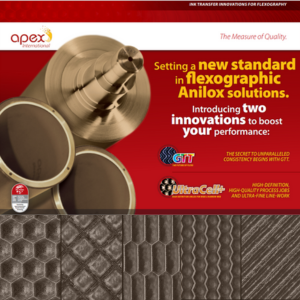
Anilox Rolls
A Full Range of Anilox Engraving and Sleeves

60° Hex
Scope / Best Working Environment
The 60° Hex engraving is best suited to:
- Thinner and less viscous inks up to 24 seconds on Din 4 / 30 seconds Zhan 2.
- Solvent based inks or coatings.
- Minimal doctor blade pressure.
Note: Choosing the correct engraving is critical to the success of this standard engraving.
Best Market Sector – Solvent based flexible packaging.
Worst Market Sector – High viscous inks and coatings with large pigment particles.
| Pros | Cons |
|
Industry standard for many years |
Can have inconsistent transfer from the same line screen and volume – shape/walls/depth. |
|
Uniform angle |
Has restricted print range. Large inventory needed to cover all aspects of designs. |
|
Good dot support |
Can contribute to ink spitting. |
|
Universally available from all suppliers |
Can have weak walls when extreme specifications are requested. |
| Maximum cells per square in/cm | Requires regular cleaning and maintenance. Requires more plate cleaning, especially on long runs. |
| Angle does not clash with YMCK plate angle. | Creates ink foaming in water-based inks and coatings by introducing air into the chambers. |
| Can create ghosting effect | |
| Can create misting on very high speeds |

GTT
Scope / Best Working Environment
The GTT engraving is best suited to:
- All markets. GTT is a universally exceptional Swiss Army Knife of an engraving.
Note: Understanding the engraving technology is critical to the success in selecting the correct GTT engraving.
Best Market Sector – Universal high-quality performance in all market environments. This technology is exceptional for ECG printing, UV inks, water-based inks, and added value lacquers.
Worst Market Sector – Old crowned rubber roller systems.
| Pros | Cons |
|
Fixed wall to depth pattern |
Higher initial cost |
|
Better print consistency |
Operator understanding |
|
Improved ink transfer |
Sales messaging |
|
Better solids |
One global supplier |
| Less cleaning | |
| No foaming since there is no air introduction into the chamber systems | |
| Reduced anilox inventory | |
| Reduced ink / coating costs | |
| Most repeatable anilox in the market | |
| ECG enabler |

45°
Scope / Best Working Environment
The 45° engraving is best suited to:
- Course engravings typically lower than 150 l/cm / 60 lpi.
- More common in chrome rollers rather than ceramic.
- Generally, for basic corrugated or coating applications.
Best Market Sector – Rubber roll systems in corrugated.
Worst Market Sector – Not suitable for fine details and YMCK.
| Pros | Cons |
|
One of the original engravings |
Can have inconsistent transfer from the same line screen and volume – shape/walls/depth |
|
Uniform angle |
Has restricted print range. Large inventory needed to cover all aspects of designs |
|
Available in mechanically engraved or ceramic laser engraved |
Can contribute to ink spitting. |
|
Larger cell walls for structural support |
Angle clashes with YMCK standard angles |
| Universally available from all suppliers | 15% less cells compared to 60° or 30° engravings |
| Can create ghosting effect | |
| Not suitable for detailed printing | |
| Introduces air into the chamber systems |

Longcell
Scope / Best Working Environment
The Longcell engraving is best suited to:
- Basic solids in corrugated, especially on uncoated poor-quality board.
- Large solid print areas.
Note: This engraving was developed in 2001, however it was not accepted as an improvement of 60° by the industry. Following the GTT Technology enhancement, the Longcell was revisited by our competitors to try and compete with the emerging GTT patent. Various tricks and breaks in the wall construction of Longcell has created an engraving that increases the ink transfer and volume which assists cheaper / poor board quality.
Best Market Sector – Basic corrugated on low quality board
Worst Market Sector – High viscous inks and coatings with large pigment particles.
| Pros | Cons |
|
More volume available than 60° |
Can have inconsistent transfer from the same line screen and volume – shape/walls/depth |
|
Increased ink transfer for solid blocks |
Has restricted print range. Large inventory needed to cover all aspects of designs |
|
Universally available from all anilox suppliers |
Can contribute to ink spitting |
|
|
Can have weak walls when extreme specifications are requested |
| Requires regular cleaning and maintenance | |
| Creates ink foaming in water-based inks and coatings by introducing air into the chambers | |
| Can create ghosting effect | |
| Can create misting on very high speeds | |
| Can clash with plate screen angles | |
| No industry fixed angle. Even a 1° difference will increase the call opening top to bottom by up to 15 microns | |
| Can print dirty on fine text and edges |
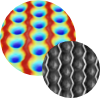
Channellox
Scope / Best Working Environment
The Channellox engraving is best suited to:
- Thick viscous inks and coatings such as UV.
Note: The Channellox was developed to break the walls running top to bottom to allow ink to flow more freely within the engraving.
Best Market Sector – Label, UV and water-based inks and coatings.
Worst Market Sector – Thinner inks such as solvent based and high-quality images and designs.
| Pros | Cons |
|
Helps to eliminate Ink spitting on viscous coatings |
Can have inconsistent transfer from the same line screen and volume – shape/walls/depth |
|
Helps to reduce foaming of the ink/coating during production |
Can lose ink print density as press speed increases |
|
Universally available from all anilox suppliers |
Can be sensitive to press pressure settings for color strength |
|
|
Print dots are less supported |
| Can print dirty on fine text and edges | |
|
Transfer performance consistency can be variable |
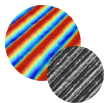
Trihelical
Scope / Best Working Environment
The Trihelical engraving is best suited to:
- Thick viscous inks and high-volume requirements.
Note: The Trihelical engraving was developed as a course engraving to create deep channels creating volume possibilities with a strong wall surface.
Best Market Sector – Coatings and large particle ink and liquids.
Worst Market Sector – Any form of image or design printing in flexo, label, or corrugated.
| Pros | Cons |
|
High volumes are possible |
Can lose coat weight as press speed increases |
|
Delivers maximum transfer to heavy and direct coatings |
Can be sensitive to press pressure settings for coating weight |
|
Universally available from all anilox suppliers |
Transfer performance consistency can be variable |
|
Good durability against doctor blades |
Generally, engravings up to a maximum of 80 lpcm / 30 lpi |
| Can create aeration in the coatings |

60° Bottoms Up
Scope / Best Working Environment
The 60° Bottoms Up engraving is best suited to:
- Glue, starch, or silicon applications.
Note: The positive engraving is a raised engraving where the volume is created in the valleys between the engraved pins.
Best Market Sector – Silicone, glue, and direct coatings
Worst Market Sector – Any form of image or design printing in flexo, label, or corrugated
| Pros | Cons |
|
High volumes are possible |
Can lose coat weight as press speed increases |
|
Delivers maximum open volume areas across the surface |
Can be sensitive to press pressure settings for coating weight |
|
Universally available from all anilox suppliers |
Weaker surface structure due to having pins instead of walls |
|
|
Generally, engravings up to a maximum of 60 lpcm / 23 lpi |
| Can create ink splashing at high speeds |

45° Bottoms Up
Scope / Best Working Environment
The 45° Bottoms Up engraving is best suited to:
- Thick viscous coatings such as glues and adhesive applications.
- Silicone and cold seal applications.
Best Market Sector – Cold seal and silicone.
Worst Market Sector – Print and packaging with doctor blade chamber systems.
| Pros | Cons |
|
Very open engraving structure |
Minimum surface contact points meaning a weaker structure |
|
Good liquid transfer capabilities especially with thick and viscous coatings |
Fast wear if used with doctor blade chamber |
|
Less cleaning required |
Fast wear if used with aggressive pigment inks |
|
No foaming |
Volume consistency has a higher tolerance |
| Minimum surface tension of anilox | Roll to roll repeatability has a bigger tolerance |
|
Ink or coating leaking if used with low viscosity inks |